* GDP (total, inflation deflator accounting, by domestic PPP and growth in percentage)
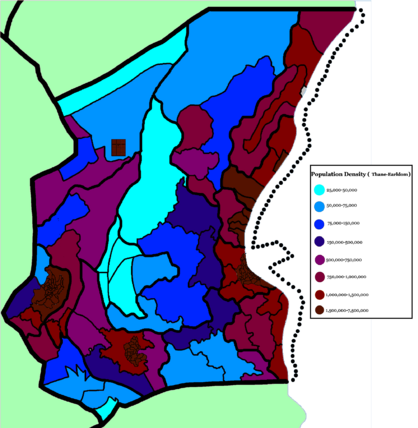
* [[File:Map-Nasphilitae-Population-Density.png|thumb|428x428px|Population Density by Region]]GDP (total, inflation deflator accounting, by domestic PPP and growth in percentage)
* GNI (total and per capita both utilising the Atlas method)
* GNI (total and per capita both utilising the Atlas method)
The Nasphiliti political & justice system has been described as "confusing" by foreigners. Nasphilitae is a highly localised, regional, Electoral monarchy, with an Uncodified constitution.
The country's Head of Government is the Head of Government and Speaker, elected every seven years, as the leader of the winning political party in the Lower House National Elections. The Head of State holds the title of Grand Duke, nominated among the Fiften Peers (uniformly called "The Peerage") by other Peers and Earls, prior to the winning nominees being subject to National elections, after which they serve for life. The official and mandatory language of Nasphilitae is Austral, though most of the citizens speaks at least two additional languages fluently due to the education systems emphasis on regional cultural studies.
Importantly, the domestic, common law does not recognise the concept of "ethnicity" nor does the National Registry conduct it. A similar, though harsher, regulations exist regarding religious affiliation. Namely, it is prohibited from confessing which denomination or religion citizens adhere to in public, justifying it by the commonly held belief that religious freedom is best kept if it is kept private. However, the National Registry conducts information classified as "Theism" or "Agnostic Theism", with Atheism being prohibited, despite Nasphilitae being a secular country. With 96-98% of the population identifying as "Theistic", Nasphilitae is one of the most religious countries in the South Pacific.
It is, counter-intuitively to previous statements, notable that Nasphilitae is both very assimilatory and multicultural at the same time, likely due to periods of high immigration usually during global conflicts, coupled with historically lax immigration laws. One of the reasons for high immigration is that Nasphilitae has never participated directly in an external armed conflict and has had only a single armed conflict inside the country during collapse of the Military Junta regime in 1958-1963.
Using the RANASA Classification System of countries by criteria of power projection, Nasphilitae is classified as an "Emerging - Middle Power", likely as a result of historic Cultural-Diplomatic power. Nasphiliti economy has been defined as: "developing", "emerging", and particularly atypical "New RE-Industrialised Economy". It is characterised by: Strict division within the labour sector (Departmentalised); High inequality (more pronounced vertically-regionally than through class-horizontally); Three recognised types of Property ownership (Private, State, Public/Collective); Former monopoly on some financial services; Experience with Postindustrialism; Subsequently (as consequence thereof), experience with ISI RE-industrialisation. It is an observer of the World Forum, represented by Head Ambassador Md Adrianna Rolson, participating in four of five WF Committees(Climate and Environment, Economy, International Law, Science and Education), with high likelihood of seeking future membership in The IUFA.
Nasphilitae is located entirely in the southern temperate zone, covering approximately 48°-55° South and 22°-to 26° West, anchoring the eastern coastline of the Crabry continent. Internally, it can be divided between four-to-five internal regions, by criteria of both physical geographic (biome differences, topographical differences, annual precipitation, geological, pollutant and temperature differences) and geopolitical (administrative sub-divisions, regional wealth disparity and development, population density) factors.
Map of Nasphilitae Regions showcasing financial inequality among them.
Additionally, the four Urban settlements (from most to least populated):Agorport (~5 million), New Sorthane (4 352 907), Suhavenster (3.75 million), and the noble-exclusive Fort Masontown (500 000 non-permanent residents) can be classified from Metropolis Cities (in the case of Agorport), over Urban Conglomerates (New Sorthane and Suhavenster), to Town-Cities (Fort Masontown) by number of residents. Most of the 17.77 million Nasphiliti citizens live in a "J" line, stretching from the furthest north-east coast and down the rest of the coastline (pronounced in and around Agorport) , to the "South Mountlands" on the border with Jakub (mostly in and around New Sorthane and Suhavenster).
Administratively and by Vertical division of power, Nasphilitae is divided on a "duplicate tri-mensional plane". The noble tenures of Thanes(belonging to "Peers") and Earldoms (belonging de jure to "Earls") serve as the highest sub-national dimension. However, the "Earldoms" are also recognized as highly autonomous Regions, each which have their own local "Regional Assemblies" (not to be confused with Parliaments).
Each "Region" is subsequently divided into Localities with significant political power (most pronounced by the fact that each "Locality" is represented by their respectively elected delegate in the Upper House).
They serve as the second dimension of sub-national division. Finally, each of the four aforementioned Urban settlements are further internally administered by Urban Councils, who electors nominate "Executive Mayors of Urban Center (Name)". The convoluted administrative-political design of "Urban settlements" are the lowest and final dimension of the vertical plane.
Discovery of shipwreck ruins in the relative shallow water laying in proximity to the North-East of Nasphilitae suggests that numerous voyages were attempted prior to 1589. Further study of their design confirmed earlier speculations that they the crewmen were in some way affiliated to or originated from the Austral Empire, though the navigators' motivations remain unknown. Reasons for the errors in sailing can mostly be attributed to storming instability of maritime pathways in the Ocean south of the Supra-Capricorn, as well as primitive and/or ill-equipped navigation technology. For this reason, the North-East Earldoms still carry names which allude to "Shipwreck", most prominent being "Earldom of The Shipwreck Declination per Earl de Hanlucch".
Further in-land (dubbed "The Inlands") on the flat plains, remnants of indigenous totems survive to this day, which suggests that a still-unknown civilisation inhabited Nasphilitae prior to the first Austral settlers. Such estimations are further amplified, deeper inside the country along the South and West Mountlands, where cave systems can be found. Namely, in passable portions of these caves, drawings and burial tomes can be found with ornaments resembling those of the totems.
Settlement period (1589-1661)
Nevertheless, the first well-documented voyage, lead by Sir Edward Turner in 1589. was successful. The navigation consisted of 15 ships, 5 of which were warships lead by the flagship which Turner was steering, 7 which were merchant ships supposedly escorted by the warships, and 3 which were either civilian, noble or slave ships. From the last three ships, five of the first "Peer Dynasties" landed on Nasphilitae with Turner: Pellmore, Morrisson, Ernst, Atkinstons, and Darzen. Not much is known about Sir Edward Turner after this event. However, it is estimated that he came from a noble Austral lineage and returned to the Empire afterwards, namely as he was accredited & carried with him "The Act of Settlement (1589) of Nasphilitae". With it, he had established the first Five Peer-Colonies of Nasphilitae, loyal to the Austral Crown but which exempt "those born on the Nasphiliti soil from religious prosecution elsewhere within Imperial lands". It should be noted that despite us referring to them as "Peer Dynasties", they've originally carried the title of "Earls".
Much alike Sir Edward Turner and the first five "Peer Dynasties" which established the "Five Peer-Colonies of Nasphilitae" in 1589., it is unknown where their noble title nor tenure originates from, though the blessing given in "The Act of Settlement" by Austras Crown provided (and yet still does) enough legitimacy in the eyes of most commoners. Over the course of the next century, remaining 10 "Peer Dynasties" soon followed this settlement, in this order: Konevengel, Schlesinger, Morganfort, Stoneham, Taylor, Fieldler, Edwards, Mason, Adamson and finally on 21. of June 1658., Greenhill.
Upon the arrival of Earl John Greenhill (June 21.1658.), he was granted what is now "The Thane per Peer Greenhill", which surrounds present-day Fort Masontown. By profession a Notary, he had opened the first (and at the time only) Workshop for Paper, Copying and Stamps. Some time in mid 1659., he expanded his profession to Coin Minting and was chosen as the Collective Treasurer by the other 14 Earls later that same year. Next year, the Austral Empire notified that a Royal visitation was being prepared to land in the Colonies of Nasphilitae, as to assess whether it was "Adequate for an honorary Credence". Earl John Greenhill was elected among the 14 Earls to be the Representative Host of this visit. For the next 10 months, Earl John Greenhill began constructing what is now "Fort Masontown", as a Palace for guesting the Imperial Delegation.
The Imperial Visitation had landed on September 15. 1661. in Agorport. They've spent the following 3 months in the barely-constructed "Fort Masontown", hosted by John Greenhill. Negotiations and informal discussions between the Visitors and Greenhill remain still unknown. However, they appear to have been successful, as Nasphiliti Colonies have received the aforementioned "honorary Crede". Upon their leave, on December 15. 1661. in Agorport, Earl John Greenhill had presented "THE IMPERIAL ORDINANCE OF NASPHILITAE ESTABLISHMENT", which had united the Fifteen Colonies into a single entity. The Ordinance had also envisioned that the Imperial Delegation select a "Peer-General", which would act as "Governor-General" of the Nasphiliti Earldoms before the Austral Crown. However, this was rejected by John Greenhill during the ceremonial declaration, giving all other Noble Earls the status of Peers.
A Council was convened between the Fifteen Peers on March 1st 1662., presided over by John Greenhill, which coined the (still used) term "Peerage Meeting". Known as "The Long Peerage Meeting", the convention lasted until November 10th., when "Peer-General" John Greenhill would adjourn it by presenting Home Rule Act of Nasphilitae (1662) preamble which contained Greenhills Five Clauses. Most important of which turned Nasphilitae into an Electoral Dominion. The Grand Peer-General was to be elected among one of the Fifteen Peers by the remaining Fourteen Peers. Secondly, it rose Nasphilitae to the status of Dominion. Lastly, it guaranteed "The freedom to conscience", which re-affirmed religious freedom in Nasphiliti soil and would later serve by the judicial practice in introduction of basic political and human rights within Nasphilitae. It remains unknown whether the status of Dominion was pre-negotiated with Imperial Delegation of the Austral Empire a year prior, though the fact that it was accepted by the Imperial Crown leaves most to rightfully speculate so.
Consolidation Period: Acts of Electoral Peerage (1777-1851)
The following include the most noteworthy elected Grand Peer-Generals from the death of John Greenhill (March 27. 1699) to the reign of "Queen" Dorothy Atkinsons, as well as note-worthy Acts passed by each.
Rulers and Acts (Nasphilitae Dominion)
John Greenhill (11.10.1672 -- 03.27.1699)
Elton Morganfort (03.30.1699 -- 12.21.1742)
Finished construction of Fort Masontown
Began expansion of Agorport deeper inland
Expanded Agorports docking capacity
Ordinance Establishing the Privy Council
Ordinance on Land Taxation(tied titled nobility to their land tenure)
Avery Konevenagel (01.03.1743 -- 07.24.1771)
Founding of Suhavenster
Act Establishing Dominions Assembly Estates
Ordinance of Clerical and University Autonomy
Act Establishing Dominions Royal Mint
Construction of the Royal Mint and the Royal Treasury in Agorport
Millferd Mason (07.27.1771. -- 09.13.1823)
Ordinance Regulations on RANASA and Fort Masontown
Ordinance on Assembly Representation
Ordinance Establishing the Supreme, Royal, and High Courts of the Dominion
Ordinance Introducing Status of Peer-selected Earls
Founding of New Sorthane
Expanding Act on Gendered Royal Titles(allowed female Peers to be elected as Grand Peer-General of the Dominion)
Construction of Coastline pre-factories and trade outposts
Watson Evans Taylor (09.17.1823 -- 12.28.1850)
Consolidation Act on Rationalised Assembly Representation(prohibited nobility from holding seats in the Assembly)
Representation of the People Act 1
Act of Commoner Suffrage(introduced universal, landed ballot voting for the Assembly)
Ordinance on Judicial Independence
Ordinance on Industrial Tax Exemption
Act on Tariff Exemptions
Consolidation Act Regulating Anti-Trust Laws and Chartered Companies 1
Demographic and economic data in Nasphilitae is conducted a series of automated services, aggregated into The National Registry. Nasphilitae does not conduct ethnicity, race, nor religious affiliation(s) of its' citizens in official data; Opting to presume that all citizens are Nasphiliti by right of soil, although a naturalisation program exists as well. However, dual citizenships are not recognised. Despite this, 3/5th of the population speak at least two additional (other than Austral) languages fluently, likely as a result of the education systems emphasis on teaching foreign cultures.
Population of Nasphilitae (2013-2023)Inflation, Unemployment and GDP % changes (2013-2023)
The Nasphiliti society is contradictory in its' statistical showcases. One example is the combination of: a high fertility rate (2.11, 2022.) , constant population growth of 1.85-2.15% (average by decade), low birth mortality rates (1 per 1750, 2023.), high percentage of urban population (89.31%, 2023.), yet a life expectancy of merely 68.88 years. An immediate assumption could be made that this is due to lack of economic opportunity, which does exist, though such an assumption would be wrong. Namely, there's been an inverse cross-correlation between declining unemployment numbers (14.91% -- 2.85%) and decrease in life expectancy (78.7 -- 68.88) between 2013-2023. Another common misconception is deficient education or participation in active work, which is an anomaly by itself. All this together means that Nasphilitae is a relatively young nation, despite its' relatively middle-to-high living standards.
As per the anomaly, expected (and mandatory) years of schooling in Nasphilitae is 14, though the mean median years of education is 17.51. This is likely due to the "Mandatorian education system" in Nasphilitae, which combined elementary, primary and secondary education into a single certified diploma; Making the basic education last until the age of 21-23. Vocational and/or University education (as it begins later) are also a contributing factor.
Low life expectancy stems from three causes. The Nasphiliti suffers greatly from tobacco (30.3% of adult population) & amphetamine (27.38% of adult population) addictions; It is estimated that 17% of all deaths are caused by heart stroke. The second is pollution, which has risen from 39% in 2013. to 66% in 2023. as the leading cause of all deaths. Finally, Nasphilitae does not have universal healthcare, which accounted to 15% in 2013. and 5% in 2023. deaths.
Due to Replication Crisis in Science, statistics gathered are later usually contextualised and analysed by appropriate institutions or researchers. The following data is conducted and published annually:
Population (total and growth in percentage)
Fertility rate (annual)
Population Density by RegionGDP (total, inflation deflator accounting, by domestic PPP and growth in percentage)
GNI (total and per capita both utilising the Atlas method)
Life expectancy at birth (total in years)
Urban and Rural population (total and by percentage relative to total population)
Compulsory education enrollment, literacy rate and education rate (total and by percentage relative to population)
Inequality (utilising the Gini index)
Unemployment (total, percent relative to total labour force)
Access to basic necessities (electricity, drinking water and broadband, all in percentage to total population)
Prevalence of undernourhisment and malnourishment (percentage to total population)
Total psychoactive consumption rates per year for all over the age of 15 (Tobacco, Amphetamines, MDMA and controlled substances like Alcohol)
Prevalence of tobacco and amphetamine use (by percentage of adults relative to total population)
Control of Corruption (estimate by citizen polling data)
Government Effectiveness (scoring value, measured by effective enforcement of policies)
Political Stability and Absence of Violence or Terrorism (cross-examination method used)
Rule of Law (multiple sample analysis of citizens polling data, institutional efficiency, public official accountability and absence of violent crime)
Automated Census:
(WIP TABLE)
Criticism regarding lack of Personal Identity Data Privacy laws:
(WIP: CURRENTLY ROLEPLAYING)
Internationalisation of the World Forum Law:
Nasphilitae had internationalised World Forum legislation over the course of January to February of 2024. The Codifying Internationalisation of International Law & Customs Act of 2024. adapts all existing WF Resolutions and extensively codifies non-WF International customary law as well. By "internationalisation" it is meant that these rules have been included within the domestic legal system, granting them the same strength and status as domestic legislation.
The Act was passed prior to Nasphilitae submitting to join the World Forum as an Observer state. Interestingly, the Act includes a provision in which any violation of either World Forum (imperative or not) legislation or general customary International law is met with automatic sanctions. These sanctions are "universal" in scope -- meaning they apply to: foreign state, business/private or physical/individual entities; as well as domestic public officials, private or physical entities.
Cultural Exchange Institutes (Active and Planned):
Electoral process in Nasphilitae as of 2024., rough Diagram.
The National Parliament exercises legislative power through The bicameral Lower and Upper Houses. The National Parliament of Nasphilitae is committee-oriented, rather than debate-oriented. However, the following two "cabinets" are limited to 10 total main ones and hold no authority over "HM Cabinet", which are covered in the fourth paragraph. The Head of Government chooses his "cabinet", called "Executive Offices", together representing the executive separated duty of Nasphilitae. The Head of HM Shadow Cabinet chooses his "cabinet" (which mirrors resors of the previous), called "Head Committees", together representing the legislative control over the executive duty. Finally, "The Plenary Committee" is comprised of MPs in the Upper House, which have been left without membership in either the Executive Offices nor the Head Committees nor their sub-organisational bodies. The Plenary Committee is tasked with judicial-legislative review of all Public Offices (with exception of the Judiciary branch) in Nasphilitae, thus it utilizes the Parliamentary privilege to inquire and prosecute other Public Officers. The Plenary Committee works in the interest of the Nasphilitae Public Safety and Collective Interests.
This system has been termed by Robert Stenhouse as "majoritarian proportionalism" and "a web of matrices checking and balancing one another".
Nasphilitae uses mostly a mixture of Common Law and Customs Law legal systems. Importantly, due to the Home Rule Act of 1661 automatically prohibiting all which isn't explicitly legal, The Nasphilitae philosophy of politics and justice rely on negative rights presumptions and positive rights aspirations. The Nasphiliti institutions mimic the Nasphiliti culture of "Natural-Real Law" traditions in legal and political philosophy.
The Lower House MPs (213) are elected every five years on a national level using a two-round voting system. The First Round uses a Droop Quota proportional representation for 1/3 the total seats. The Second Round, held 5 days after the First and ballot which is comprised of the two parties with the most votes in the first round, uses a relative majority FPTP voting system. Leader of the winning party in the Second Round is the Speaker and Head of Government, while his second-round opposing candidate is the Head of HM's Shadow Cabinet. MPs of the Lower House represent the Will and protect the interests of Nasphilitae Collective (including the state, citizens, and private entities).
The Upper House MPs (631) are elected every seven years on a local/municipal level using a relative majority winner-takes-all system. Each voting constituency winning ballot sends a delegation to the Upper House. The MPs of the Upper House represent the Will and protect the interests of their local constituency and (also often, although not legally obligated) Region/Earldom.
Upper House after 2024 elections.Lower House (includes 2nd round) 2024.
The Head of State holds the title of "Grand Duke" of Nasphilitae. First, three are elected among the Fifteen Peers by the 75 Earls. Then, multiple rounds of National votes may be held, until one of the three candidates receives absolute majority (more than 50%+1 of the vote) The Grand Duke serves for life and works in the State and Public interests of Nasphilitae. The Grand Duke selects his HM Cabinet Leaders. These Cabinets cover the resors of: International Relations (currently, Earl Quinlann Emmerson); Armed Forces of Nasphilitae (currently, General-Peer David Atkinsons); and Agency for Identification and Documentation (currently, Peeress Maddison Edwards).
(WIP: CURRENTLY IRPing. Impossible to write prior.)
History and Cliometrics of Nasphiliti Economy
Cliometrics of Nasphilitae by Sector
Nasphiliti economy has historically been driven by three major sectors: Agricultural-Distribution Chain Monopoly of the Nasphiliti Nobility, Financial-Trade-Docking-Shipping Services, and Workshop-Mechanisation-Industrialisation-Reindustrialisation Factories. As Candice & Kamala Cohen have noted in their works, the "Golden Age" of Nasphilitae during the reign of Queen Dorothy Atkinsons comes from one crucial policy enacted by her: "Monetisation-Fiscalisation" of colonial duties. With it, Nasphilitae has been lifted of mercantilism and was granted right to free trade with other countries in exchange for annual payment to the Austral Empire.
Observable contributions, albeit minor, have continuously been in the sectors of: (Ship/Mechanical/Product) Maintenance Services, Processing raw materials into intermediary industrial goods, as well as the Woodworking-Carpentry-Construction chained sectors. Recent developments include: Research & Cryptography, which aided the development of an early Technology sector, particularly within Computational-Security analysis (such as Social Network Analysis) and Networking protocols. Most recently, as a result of "Import Substitution Re-Industrialisation" policies, Heavy Industrial sectors (namely, industrial design of intermediary mechanical equipment and its production) have developed; Together with Biotechnology (namely, in production of Biofuel and Pharmaceuticals). These two new sectors are likely key contributors to the ongoing pollution crisis.
Kamala Cohen (elder sister of Candice) has identified seven key periods in Political Economy of Nasphilitae by policies:
Seven Periods
Sector Focus
Relative Period
Agriculture, Workshop & Navigation
1661-1750s
Construction & Shipping Services
1750s-1851
Military-Industrial Complex & Financial Services
1851-1950s
Technology & Cryptography
1950s-1988
Post-Industrialism
1988-2001
Import Substituted Re-Industrialisation
2001-2019
The Postindustrial "Lost Decade" and Import Substitution Reindustrialisation
Infrastructural Public Work Program (2024-2025):
(WIP: CURRENTLY IRPing. Impossible to write prior.)
Key Economic Sectors (Historical):
Key Economic Sectors (From ISI):
Private, Public and State property:
Nasphilitae recognises three types of ownership-properties: Public (all citizens as a collective), State (of public officials and offices for the collective), and Private (of a citizen or a group of citizens).
(WIP)
The Education system in Nasphilitae is divided into four major groups:
The Mandatorian
The Mandatorian: Equivalent to elementary, primary, secondary and post-secondary schooling in other countries; Lasting 16 years (age 5-21). Note that completing The Mandatorian is a required for any future enrollment or employment. The Mandatorian System is divided into three "levels" within itself, based on age of the pupils and grades.
Basic Level (Age 5-11): Characterised by Minimally monitored pedagogy-tutorship approach, best described by the tutors principle of "Discipline without Punishment or Rewards" (DPR Principle). School days: 175/365. Hours per Day: 10 hours. Tutor-Pupil Number: 1-35. Subjects: Arithmetic (1-3), Art (1), Austral, Geometry (1-4), Logic (1), First Foreign Language, Physical Education.
Middevel (Age 11-16): A noticeable, stark difference is the abrupt transition into Standardised tutorship and Punitive pedagogy approaches. To couple the contrast, the amount of time expected to be invested is nearly inverse, despite the increase in subjects.. School days: 110/365. Hours per Day: 5 hours. Professor-Pupil Number: 13-25. Subjects: Algebra (1-2), Art (2-4), Austral (Linguistics), Computer Science (1-3), Chemistry (General, Inorganic), Geometry (5-8), History (Domestic), Logic (2), First Foreign Language, Second Foreign Language, Physical Education, Pre-Calculus (1-3), Regional/Strategic Studies (1).
Advanced (Age 17-21): Re-introduced the Minimally monitored approach in pedagogy, while mandating a mixture of Inquiry -- Network Peer tutorship. School days: 150/365. Hours per Day: 12 hours. Professor-Pupil Number: 9-50. Subjects: Art & Austral (Literature), Calculus & Computer Science (4), Chemistry (Organic), History (Foreign), Logic (Non-boolean), First Foreign Language, Second Foreign Language, Regional Intercultural Studies (2-5).
Post-Mandatorian University
The University:Level BA: Equivalent to Bachelor and/or Graduate Degree in other countries; Lasting four years (age 21-25). Note that BA education in Nasphilitae is tuition-free, with each half-semester requiring participation in at least one internship program by each student. However, the barrier for entrance (evident by high criteria for passing the entrance exam), as well as the curriculum are considered one of the most difficult in The South Pacific. Despite this, the Universities of Suhavenster, New Sorthane and Agorport have a 4:5 enrollment:graduation rate. Unlike The Mandatorian System, Universities enjoy a large degree of autonomy, exemplified by each their respective "Statute of the University".
The University:Level MA: Equivalent to Masters/Magistrate in other countries. It is mandated that all MA programs in Nasphilitae last for two calendar years; With the barrier of entry requiring a minimum of 8.75/10 overall BA score, coupled with the as-hard-as-BA entrance exam.
Post-Mandatorian Vocational
Technicum: Equivalent to "Trade/Vocational" education in other countries; Age above 21 with a completed Mandatorian System. Technicums enjoy the greatest level of autonomy, as the education is usually provided privately, by a Master of some Trade.
RANASA
RANASA: Limited to Nobility and the (exceptionally) talented civilians. Begins at age 3. The National Education System does not regulate RANASA programs nor protocols. It is regarded as a private educational facility, the only one legal within Nasphilitae. Located in Fort Masontown.
Due to a peculiar macroeconomic policies in the past and political economic system in the present, coupled with limited participation in the Royal Armed Forces of Nasphilitae by Ordinance on Peer Monopoly of Arms, Nasphilitae relied on Intelligence Agencies & Informational Security historically. as its main focus of the three pillars of power. Historical circumstances which invisibly guided Nasphilitae this policy include: Access to early industrialisation; Settler-colonial human capital; Distance from the Austral Empire (granting it de facto self-rule) and rationalisation of colonial duties; Skepticism towards both Empiricism of Austra and Logic reliance of other civilisations; "Observation-isolationism" - as in studying other countries from a distance, mercantile diligence; Robust education system; Early access to both political and workers rights; and the P3 Coalitions technological pedestal -- All invisibly lead Nasphilitae to early developments in Cryptography.
Historically, this has been a double-edged sword. Two events showcasing abuse of Cryptography include the Defunct Department Nine of AID and its experiments, as well as the inexistence of clearly defined boundaries which AID is responsible for.
Positively, it has brought the digital revolution early into Nasphilitae, having developed one of the first intranet networking systems and computational technologies. Still positively, the general conspiracy theories surrounding AID cause malicious foreign actors to view Nasphilitae as "too much investment for not enough gain" in attempting to conquer or coerce it.